×
× 




Trong Unit 5 Tiếng Anh lớp 8 với chủ đề Our Customs and Traditions, các bạn học sinh sẽ được tìm hiểu về những phong tục, tập quán và truyền thống quen thuộc trong đời sống văn hóa người Việt.
Trong bài viết dưới đây, IELTS LangGo sẽ cung cấp hướng dẫn chi tiết và đáp án đầy đủ cho từng phần trong Unit 5, giúp các bạn ôn tập và tổng hợp kiến thức hiệu quả. Cùng khám phá ngay!
Phần mở đầu là cuộc trò chuyện giữa Elena và Trang xoay quanh việc chuẩn bị cho Tết Nguyên đán. Qua đó, bài nghe đã cung cấp từ vựng về các hoạt động và phong tục truyền thống của người Việt.
Đáp án:
1. F - Elena and Trang are at Sa Dec Flower Village.
2. T - Many people visit flower villages to take photos.
3. T - Trang’s family usually buys kumquat trees and peach blossoms at Nhat Tan Village.
4. F - Flowers are not part of any Vietnamese traditions.
5. T - People decorate bamboo poles with small bells and lanterns for New Years.
Đáp án:
1 - d: ornamental tree
2 - a: bamboo pole
3 - e: decorative items
4 - b: blooming flowers
5 - c: communal house
Đáp án:
1. The British decorate their Christmas trees and place presents under them.
2. Tom likes to admire the view from the hill.
3. In many cultures, knocking on wood is a way to chase away bad spirits.
4. Many Asians go to Buddhist temples to pray for good luck.
People around the world celebrate New Years differently. Choose the country with each tradition below.
Đáp án:
1. Visiting pagodas => B. Viet Nam
2. Throwing water at each other. => A. Thailand
3. Ringing a bell 108 times. => A. Japan
4. Giving and receiving lucky money => B. Viet Nam
5. Watching a ball drop at midnight in Times Square => B. The US
>> Xem chi tiết hướng dẫn giải tại đây: Tiếng Anh 8 Unit 5 Getting Started
Phần bài học này giúp củng cố từ vựng chủ đề Our Customs and Traditions và luyện phát âm /n/ và /ŋ/ qua các bài tập thực hành.
Đáp án:
1 - family reunion
2 - wedding ceremony
3 - food offerings
4 - whale worship
5 - martial arts
6 - festival goers
Đáp án:
1. We have a tradition of holding a family A. reunion on the first day of Tet.
2. It’s a tradition for shops to have a lion dance performance at their opening C. ceremony.
3. The tradition of B. worshipping whales is popular in Vietnamese coastal villages.
4. She broke with family tradition by not practising B. martial arts .
5. Traditionally, the Vietnamese prepare A. offerings to worship their ancestors during Tet.
Đáp án:
1. This year, we will break with tradition and go on holiday instead of staying at home during Tet.
2. Traditionally , children in the US go from house to house to ask for sweets on Halloween.
3. Holding a party to wish our grandparents longevity is one of the customs we practise at Tet.
4. Organising a folk song club is one way for us to keep our traditions alive.
5. It’s becoming a custom for young people to celebrate New Years in addition to Tet.
| /n/ | /ŋ/ |
| thin, land, ceremony, longevity, tradition | thing, thank, single, language, offering |
Đáp án:
1. Mary wore a pink dress last night.
2. I think we should buy this ornamental tree.
3. He thanked the host for the enjoyable party.
4. My mum made the spring rolls for the longevity party.
5. I will bring some food to the party on Saturday.
>> Xem chi tiết hướng dẫn giải tại đây: Tiếng Anh 8 Unit 5 A Closer Look 1
Phần bài tập này tập trung vào chủ điểm ngữ pháp về các trường hợp không dùng mạo từ (Zero Article).
Đáp án:
1. (A) The worshipping Kitchen Gods is (B) a long-time tradition of (C) the Vietnamese.
→ A. The => Ø
2. People organise (A) the worshipping ceremony at (B) noon so that (C) a Kitchen Gods can leave for Heaven at 12 o'clock.
→ C. a => The
3. (A) Most families in the Viet Nam prepare (C) offerings for the Kitchen Gods.
→ B. The => Ø
4. (A) The offerings include a set of flowers and fruits, (C) a paper clothes, and three carps.
→ C. a => Ø
5. (A) The Vietnamese people believe that the Kitchen Gods go to Heaven on (C) carps.
→ A. the => Ø
Đáp án:
Đáp án:
(1) the
(2) Ø
(3) Ø
(4) Ø
(5) the
Một số câu ví dụ:
→ the => Ø
→ a => the
→ the => a
>> Xem chi tiết hướng dẫn giải tại đây: Tiếng Anh 8 Unit 5 A Closer Look 2
Phần này giúp các bạn học sinh nắm được cách đưa ra lời khuyên (Giving advice), đồng thời tìm hiểu về múa sư tử ở Nhật Bản và múa lân ở Việt Nam.
Tom: My parents are taking me to their friend’s house for dinner. Could you tell me a bit about Vietnamese table manners?
Mai: Well, perhaps you should wait for the host to start eating.
Tom: I will.
Mai: It’s a good idea to hand bowls with both hands.
Tom: Sure. I’ll remember that one.
Mai: And don’t hit the bowl with your chopsticks. This may bring bad luck to the host family.
Topic 1: Student A is travelling to Sa Pa in winter. He/She doesn’t know what to wear. Student B gives advice.
Hội thoại gợi ý
A: I’m going to visit Sa Pa this winter, but I don’t know what to wear. Do you have any advice?
B: Well, it’s very cold there in winter. Perhaps you should bring warm clothes like a thick jacket and sweaters.
A: Okay. Should I bring skirts or shorts?
B: No, don't wear shorts. It's a good idea to bring a scarf and gloves to keep yourself warm.
Topic 2: Student A is going to a birthday party. He/She doesn’t know what kind of gift to bring. Student B gives advice.
A: I’ve been invited to a birthday party, but I don't know what kind of gift to bring.
B: Who is the party for?
A: It's for my close friend, Lan.
B: It's a good idea to give her something meaningful, like a book or a handmade card.
A: Should I buy an expensive toy?
B: No, you shouldn't spend too much money. Perhaps you should just buy her a nice notebook or some cute pens.
Đáp án:
(1) shishi-mai
(2) New Year celebrations
(3) controls the lion’s head and the other moves the lion’s body
(4) flutes and drums
(5) bad spirits
Gợi ý thảo luận:
Both Vietnamese mua lan and Japanese shishi-mai are traditional dances performed to bring good luck. They are often seen at special occasions like New Year celebrations, weddings, and business openings. In both dances, performers need to be skilled at acrobatics. However, there are some differences. In Viet Nam, mua lan is also performed at the Mid-Autumn Festival, while shishi-mai is mainly for New Year. Regarding music, the Vietnamese dance uses drums, but the Japanese one uses both flutes and drums. Another difference is that the Vietnamese unicorn often dances with Ong Dia, whereasthe Japanese lion dances alone or follows the musicians. Finally, while mua lan wishes for success, shishi-mai focuses on chasing away bad spirits.
>> Xem chi tiết hướng dẫn giải tại đây: Tiếng Anh 8 Unit 5 Communication
Phần này tập trung vào 2 kỹ năng là Reading với bài đọc về một ngày hội làng tại miền Bắc Việt Nam (A village festival day) và Speaking với chủ đề sự kiện gia đình (family events).
Gợi ý trả lời:
→ They are rowing a boat and cooking rice at the same time.
→ I think it occurs during a traditional festival or at Tet.
Đáp án:
Đáp án:
(1) third day
(2) home
(3) dishes
(4) food
Đáp án:
(1) - B. Lan, what family event do you often take part in?
(2) - D. Where do you hold these parties?
(3) - E. Who joins you at these parties?
(4) - A. And what do you do at parties?
(5) - C. Do you like these parties?
Gợi ý trả lời:
Now work in pairs. Make a dialogue asking and answering about the event. You can use your notes.
Hội thoại gợi ý:
Student A: What family event do you often take part in?
Student B: Well, my family always gathers for a Year-end party before Tet.
Student A: Where and when does it happen?
Student B: It usually takes place at my grandparents' house on the last day of the lunar year.
Student A: Who joins with you?
Student B: All my relatives come. Uncles, aunts, and all my cousins. It's very crowded!
Student A: What do you often do at that event?
Student B: The adults cook traditional food like Banh Chung and boiled chicken. We play games and talk. We also talk about the old year and give lucky money. Then we have a big meal together.
Student A: Do you like it?
Student B: Yes, I love it. It's the best time for family bonding.
>> Xem chi tiết hướng dẫn giải tại đây: Tiếng Anh 8 Unit 5 Skills 1
Phần bài tập này mang đến chuỗi bài tập rèn luyện 2 kỹ năng Nghe và Viết thông qua chủ đề Lễ hội Việt Nam, giúp học sinh vừa học ngôn ngữ vừa hiểu thêm về văn hóa truyền thống.
Gợi ý trả lời:
→ In photo a, I can see colourful lanterns on the water. In photo b, I can see a boat race (Ngo boat race).
→ It might occur in the Mekong Delta
Đáp án:
(1) end
(2) young rice
(3) fashion show
(4) race
Đáp án:
1. TRUE - Ok Om Bok is the Moon Worshipping Festival.
2. FALSE - On the night of the festival, the elders talk about their wishes.
3. TRUE - There are lantern contests at the festival.
4. FALSE - Tourists should wear informal clothes when attending the worshipping ceremony.
| Dos (Nên làm) | Don'ts (Không nên làm) |
| a. dress up for the Moon God offering ceremony. | c. climb on the animal statues in the temple ground. |
| b. keep quiet when the monks and the elders are talking. | e. refuse young rice when the elders offer it to you. |
| d. show respect to the monks and the elders. | f. litter the temple ground. |
“… Guess what! My dad is taking me with him to Soc Trang Province. We will be there during the Ok Om Bok Festival. What are some dos and don’ts at this festival? …”
Gợi ý email phản hồi Tom:
Subject: Re: Ok Om Bok Festival
Dear Tom,
I'm so happy to hear that you and your dad are going to Soc Trang for the Ok Om Bok Festival. It is one of the most exciting festivals in the Mekong Delta! Since it is a religious festival, here are some tips for you. First, you should dress up respectfully when you watch the Moon God offering ceremony. Also, remember to show respect to the monks and elders. If they offer you some young rice, please don't refuse it. However, there are things you shouldn't do. You must not climb on the animal statues in the temple. Finally, never litter the temple ground to keep it clean. I hope you have a wonderful time there!
Cheers, Minh.
>> Xem chi tiết hướng dẫn giải tại đây: Tiếng Anh 8 Unit 5 Skills 2
Ở phần này, học sinh sẽ được củng cố lại những kiến thức nền tảng về Từ vựng và Ngữ pháp của chủ đề Our Customs and Traditions.
Đáp án:
1. It is becoming a B. custom for many families in Viet Nam to celebrate Women's Day and Family Day.
2. A. Traditionally, we hold the Spring Festival on the 15th of January in lunar calendar.
3. Janet is from a family of doctors, but she broke with A. tradition when she went to an art college.
4. Having dinner at my grandparents' house on Saturdays is one of the customs our family B. practises.
5. Story telling is a great way to B. keep the local tradition alive.
Đáp án:
1. Kien was so tall that no one recognised him at the family reunion last summer. (union)
2. My mum puts in a lot of effort to prepare offerings to worship our ancestors.
3. The festival goers gathered on the riverside to cheer the boat racers. (go)
4. Dragon-snake (Rong ran len may) is a traditional Vietnamese game for children. It is very enjoyable. (tradition)
5. We happened to see some locals worshipping animals in their village temples. (worship)
1. These days, many teenagers write Ø emails instead of letters.
2. My dad bought an ornamental kumquat tree for Tet.
3. I don't like that restaurant. The food there isn't very good.
4. Don't wear a hat when you go into a temple or a pagoda.
5. It's becoming a custom for us to stay out very late on Ø New Year's Eve.
Đáp án:
(1) Ø
(2) a
(3) Ø
(4) the
(5) an
>> Xem chi tiết hướng dẫn giải tại đây: Tiếng Anh 8 Unit 5 Looking Back
Phần bài tập này giúp học sinh áp dụng kiến thức tiếng Anh vào thực tế thông qua các hoạt động nhóm thú vị xoay quanh chủ đề phong tục - tập quán địa phương.
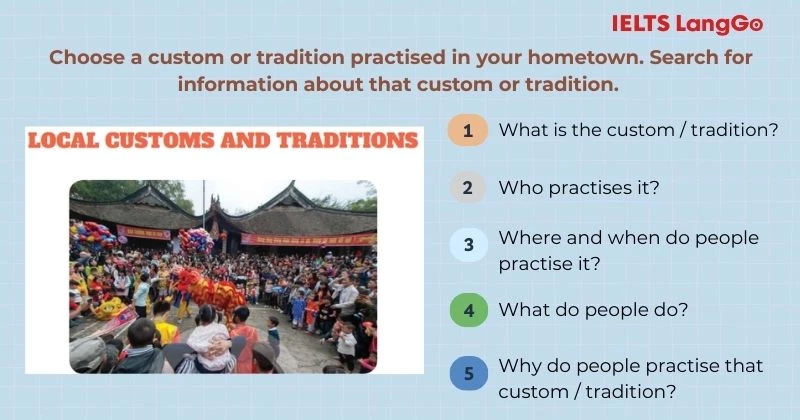
Một số phong tục gợi ý:
Gợi ý trả lời:
Gợi ý bài thuyết trình mẫu:
Hello everyone. Today, our group will talk about a very popular custom in our hometown during Tet: Giving lucky money (or Lì xì). This custom is practised by almost every family in Viet Nam, including our hometown. It usually happens on the first days of the Lunar New Year.
On the first day of Tet, children dress up in new clothes and give greetings to their grandparents and parents. Then, the adults give them red envelopes with some money inside. The red envelope symbolizes good luck and happiness. People believe that giving lucky money will bring good health and success in the new year.
We love this tradition because it brings joy to everyone, especially children. Thank you for listening!
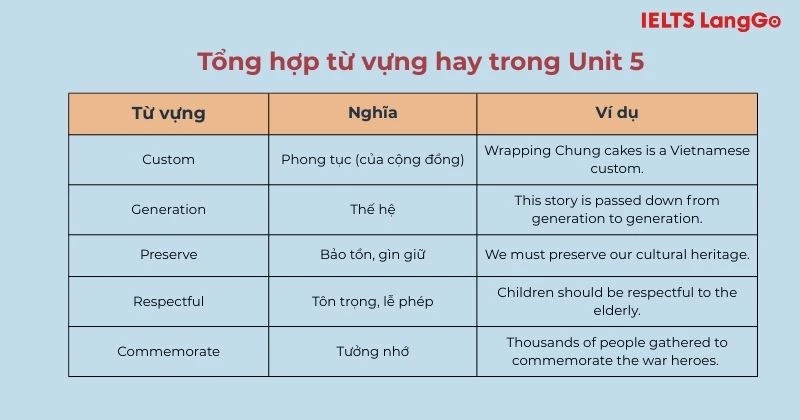
>> Xem chi tiết hướng dẫn giải tại đây: Tiếng Anh 8 Unit 5 Project
Unit 5 Tiếng Anh lớp 8 với chủ đề Our Traditions and Customs đã giúp các bạn học sinh khám phá sự đa dạng của truyền thống Việt Nam và hiểu hơn về giá trị của những phong tục gắn bó với đời sống cộng đồng. Ngoài việc bổ sung từ vựng và mẫu câu quan trọng, các bạn còn được rèn luyện 4 kỹ năng Nghe - Nói - Đọc - Viết thông qua những tình huống quen thuộc.
Hy vọng rằng phần đáp án và gợi ý trả lời từ IELTS LangGo sẽ giúp các bạn học tốt Unit 5 và tự tin hơn khi làm bài tập. IELTS LangGo luôn đồng hành cùng các bạn trên hành trình chinh phục tiếng Anh mỗi ngày!


ĐẶT LỊCH TƯ VẤN MIỄN PHÍ LỘ TRÌNH Săn ƯU ĐÃI lên tới 12.000.000đ